Financing 101 for First-Time Buyers: What Nobody Explains
Let me be straight with you. The financing part of buying a home is the piece that stresses first-time buyers out the most. And I get it. You're signing papers with numbers you've never seen before, the lender is asking for bank statements from three years ago, and somewhere in the fine print there's an APR and a PMI and an escrow account and it all sounds like a foreign language. I've been doing this for 19 years and I still think mortgage docs could use a rewrite. But here is what nobody explains in plain English.
Start here: Get pre-approved, not pre-qualified.
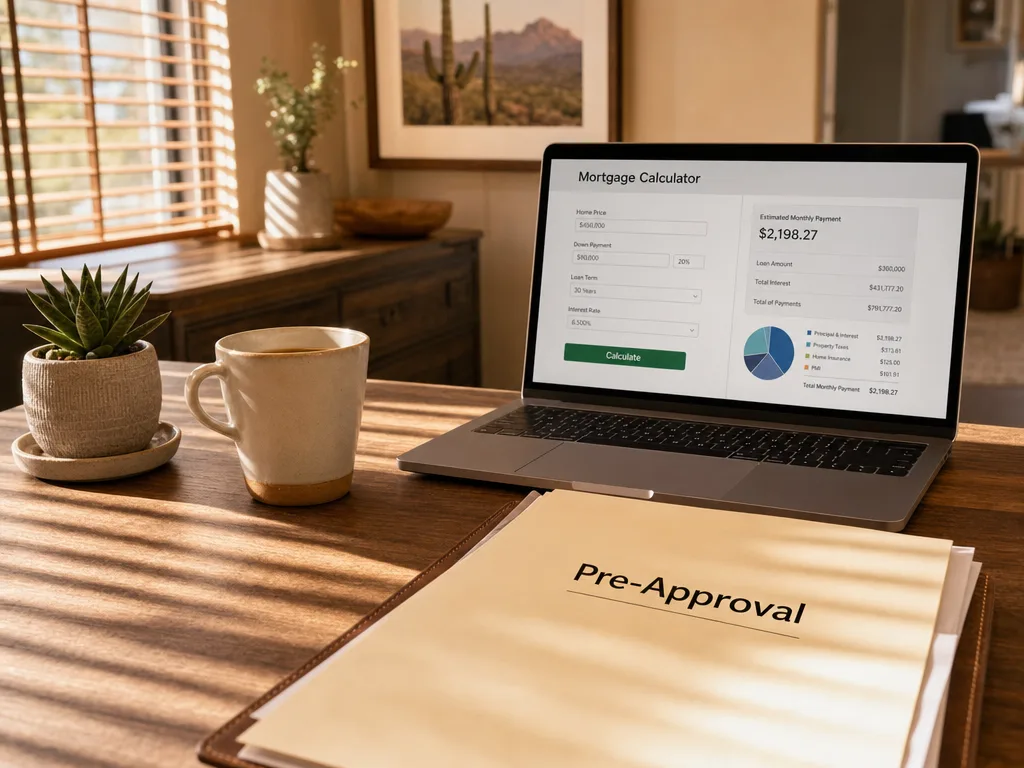
A pre-qualification is basically you telling a lender what you think you make and them guessing what you can borrow. A pre-approval is them actually verifying your income, pulling your credit, and giving you a real number. In this market, sellers in Gilbert and Eastside Phoenix want to see a pre-approval letter, not a pre-qualification. A pre-qual says "maybe." A pre-approval says "this buyer can actually close." Which one do you think wins a multiple-offer situation?
Get pre-approved before you start looking at homes. It takes a few days, it costs nothing, and it tells you exactly what price range you should be shopping in. Nothing hurts worse than falling in love with a home you cannot afford. I have seen it happen. Do not let it happen to you.
How much house can you actually afford?
The lender is going to tell you the maximum loan amount you qualify for. That number and what you should actually spend are often very different things. Just because a bank says you can borrow $500,000 does not mean a $500,000 payment fits your lifestyle. You still need to eat out, travel, save for retirement, and maybe adopt a goldendoodle like mine, Winston. (Trust me, he has opinions about the monthly budget too.)
A good rule of thumb is to keep your total monthly housing payment at or below 28 percent of your gross monthly income. That includes principal, interest, taxes, and insurance. And do not forget HOA fees and utilities. My Master's in Finance taught me one thing that has never let me down: the math has to work on paper and in real life. If the payment stretches you too thin, it does not matter how pretty the kitchen is.
Know your mortgage options.
Most buyers think there are two options: a 30-year fixed or rent forever. There is more to it than that, and knowing your options can save you thousands.
Conventional loans are the most common. You need decent credit and typically 3 to 5 percent down. If you put less than 20 percent down, you will pay private mortgage insurance (PMI). That is an extra monthly cost until you build enough equity. Plan for it.
FHA loans are backed by the Federal Housing Administration. They allow lower credit scores and as little as 3.5 percent down. The trade-off is mortgage insurance that stays for the life of the loan in most cases. Great option for buyers with less saved up, but run the numbers on the long-term cost.
VA loans are for military veterans and active-duty service members. Zero down payment, no PMI, and competitive rates. If you or your spouse has served, this is hands-down the best financing tool available. I work with veteran buyers regularly in Eastside Phoenix and Gilbert, and the VA loan is incredible when used right.
USDA loans are for buyers in eligible rural and suburban areas. Zero down payment and low rates. Parts of the East Valley qualify. Worth asking your lender about.
Credit scores matter more than you think.
Your credit score determines not just whether you qualify, but what interest rate you get. A difference of 20 points in your credit score can mean thousands of dollars in interest over the life of the loan. Before you start the home-buying process, pull your credit report. Check for errors. Do not open new credit cards or finance a car in the months before you buy. Every hard inquiry and every new account bumps your score a little lower temporarily, and that tiny dip can cost you at closing.
Closing costs are real.
Nobody talks about closing costs until you are three days from signing and the lender hands you a bill for 2 to 5 percent of the purchase price. On a $400,000 home, that is $8,000 to $20,000 above your down payment. Closing costs include the appraisal, loan origination fees, title insurance, escrow fees, and prepaid property taxes. You can sometimes negotiate for the seller to cover part of these costs, especially in a slower market. Know this going in so it does not surprise you at the finish line.
The bottom line.
Financing does not have to be scary. It just has to be understood. Work with a lender who explains things instead of just throwing acronyms at you. Get pre-approved before you start touring homes. Know what you can actually afford, not just what the calculator says. And when you have questions, ask them. That is why I am here.
If you are a first-time buyer in Gilbert or Eastside Phoenix and you want to talk through the financing process with someone who will tell you the truth, not the sales pitch, schedule a call with me. We will walk through your numbers, talk about your options, and make a plan that actually works for your life. No drama. Just answers.